
B.Sc. in Sociology
Program Profile
The Sociology Department at the University of Duhok aims to provide students with a strong foundation in classical and contemporary sociological theory, alongside a deep understanding of social structures, institutions, cultures, and human interactions.
The program develops students’ research and analytical skills through training in qualitative and quantitative methods, data collection, statistical analysis, and academic writing.
It promotes critical and independent thinking, ethical awareness, and social responsibility, encouraging students to analyze social problems, inequalities, and global changes using evidence-based approaches.
Through fieldwork, internships, and community engagement, the department builds connections between academia and society while preparing students for diverse careers in public institutions, NGOs, UN agencies, education, media, community development, social welfare, gender studies, research centers, humanitarian organizations, and related fields.
Graduates gain the knowledge, skills, and competences required by Bologna standards, enabling them to communicate effectively, collaborate in teams, respect research ethics, support decision-making processes, and pursue lifelong learning or advanced studies (MA/PhD).
Occupational profiles of graduates
- Social Researcher – Conducts qualitative and quantitative research, analyzes social trends, and prepares evidence-based reports for institutions and decision-makers.
- Policy Analyst – Works in research centers or government bodies to evaluate social policies, write policy briefs, and support planning and development.
- Community Development Officer – Designs and implements community projects, assesses social needs, and works with local communities to improve well-being.
- Social Worker / Case Worker – Supports individuals, families, youth, and vulnerable groups through counseling, intervention, and referral services.
- NGO / Humanitarian Field Officer – Works with NGOs and UN agencies in project coordination, fieldwork, data collection, monitoring and evaluation, and community engagement.
- Gender and Protection Specialist – Addresses issues related to women, children, and marginalized groups, focusing on rights, safety, and inclusion.
- Education Sector Roles – Works as a sociology teacher, academic advisor, or student support officer in schools and educational institutions.
- Media and Public Relations Officer – Applies sociological knowledge to public communication, awareness campaigns, and organizational outreach.
- Cultural Program Coordinator – Organizes and manages cultural events, heritage projects, and community cultural initiatives.
- Youth Program Facilitator – Develops and implements programs that support youth empowerment, leadership, and social participation.
- Social Welfare Officer – Works in government or community programs addressing poverty, family support, child protection, and social services.
- Data Analyst / Research Assistant – Uses tools like SPSS and Excel to analyze data, prepare reports, and support research teams.
- Project Manager / Project Assistant – Manages or supports social, developmental, and humanitarian projects from planning to implementation.
- Community Outreach Coordinator – Builds relationships with communities, organizes awareness activities, and promotes public engagement.
- Academic Researcher or Lecturer – Pursues MA/PhD studies and works in universities as a lecturer, researcher, or academic consultant.
Qualification awarded
Bachelor in Sociology
Length of programme
4 Years
Number of credits
240 ECTS credits
Mode of Study
Full time on campus, in addition to one summer internship in the third year of college.
Read more about the programme
Get detailed information about the programme requirements, courses, credits, and educational objectives as a PDF file.
Program Educational Objectives (PEOs)
1.Develop Sociological Knowledge
- Provide students with a strong theoretical foundation in classical and contemporary sociological thought.
- Help students understand social structures, institutions, cultures, and human interactions.
2. Build Research and Analytical Skills
- Train students in qualitative and quantitative research methods.
- Enable students to design, conduct, analyze, and present sociological research.
3. Promote Critical and Independent Thinking
- Encourage students to critically analyze social problems, inequalities, and global changes.
- Teach them to evaluate evidence, arguments, and theories.
4. Prepare Students for Professional Careers
- Equip students with skills needed in public sectors, NGOs, media, education, social work, community development, research centers, and policy organizations.
- Strengthen communication, teamwork, and problem-solving.
5. Strengthen Social Responsibility and Ethical Awareness
- Encourage sensitivity to social justice, diversity, gender issues, human rights, and ethical research practices.
6. Connect Academia with Society
- Engage students in fieldwork, internships, community projects, and real-world social issues.
- Build bridges between the department and local communities.
Program Learning Outcomes
Expected Learning Outcomes (Program Outcomes)
These outcomes follow Bologna standards: Knowledge, Skills, and Competences
A. Knowledge
After completing the program, students will be able to:
1. Explain major sociological theories and concepts (Durkheim, Weber, Marx, contemporary theories).
2. Describe social structures such as family, education, religion, economy, and politics.
3. Identify patterns of social inequality (gender, class, ethnicity, religion).
4. Understand globalization, social change, modernity, and post-modernity.
5. Recognize the sociological perspectives on culture, identity, and deviance.
B. Skills
Students will be able to:
1. Conduct sociological research using qualitative and quantitative methods.
2. Collect and analyze data (surveys, interviews, observations, statistical analysis).
3. Use research tools (SPSS, NVivo, Excel, content analysis).
4. Write academic reports and research papers following scientific methodology.
5. Apply sociological theories to analyze contemporary social problems
6. Communicate findings clearly in presentations, discussions, and written formats.
C. Competences
Students will develop the ability to:
1. Think critically about social norms, institutions, and policy decisions.
2. Work ethically and respect confidentiality and research ethics.
3. Collaborate in group projects, field studies, and community programs.
4. Solve social problems through evidence-based approaches.
5. Engage with society—especially vulnerable groups, NGOs, and public institutions.
6. Continue learning (lifelong learning) and pursue advanced studies (MA/PhD).
Graduates of a Sociology Department can work:
- Work in social research centers, policy institutes, NGOs, UN agencies, educational institutions, media, government offices, community programs, refugee camps, and more.
- Analyze social trends, prepare reports, support decision-makers.
- Teach sociology in schools
- Work in areas such as:
o Social welfare
o Child and women protection
o Family Support
o Schools
o Gender studies
o Development projects
o Public relations
o Cultural studies
o Youth programs
o Humanitarian organizations
o Field coordination and data collection
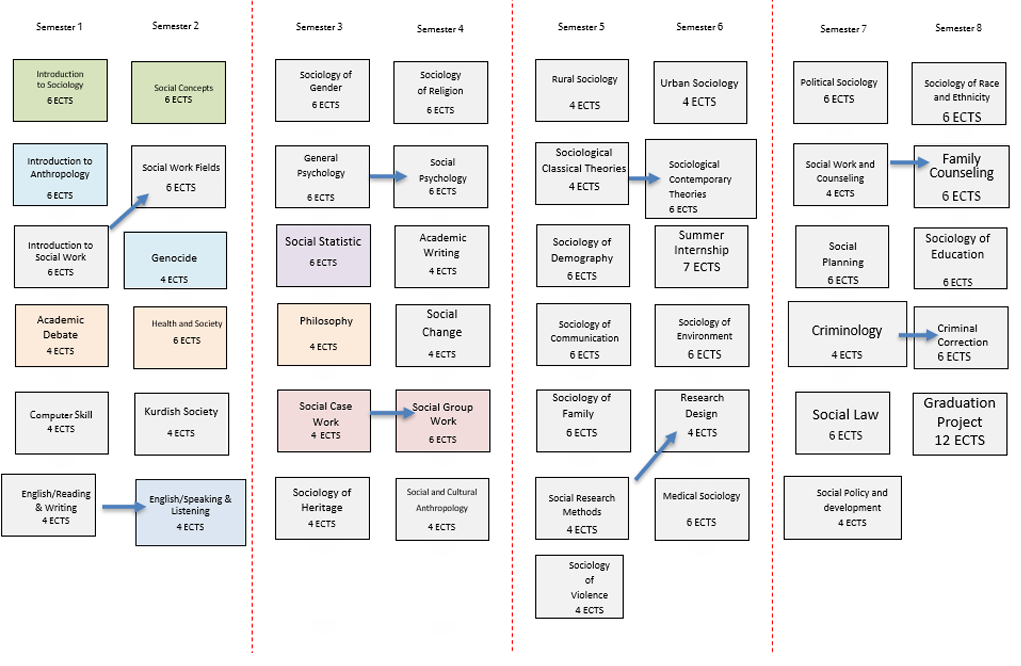
Programme structure diagram with credits
Yearly Timeline
Sept. 1, 2026
⚠️ First year students start around mid-October
⚠️ First year students start exams around 20 of January
July 1, 2027
Check out the full academic calendar on UoD's webstie.
Programme Coordinator

Lecturer in sociology
Sociology
College of Humanities
University of Duhok
Apply to the Programme
Public undergraduate admissions in the KRG region are managed centrally by the Ministry of Higher Education through the online ZankoLine portal (regayzanko.com). After Grade 12 Baccalaureate results are released, high schools provide students with unique login credentials to rank their preferred universities and B.Sc. majors during a 10–14 day registration window. Final placement is automatically determined by the student's Grade 12 average, subject choices, and department capacity.